Welcome to the blog of Alfonso López Beltrán on the Romanization and the Roman Army in Hispania and the province of Guadalajara. Here you will be able to find information on weapons, battles, camps, society, numismatics and a lot more things.Regards to everybody and welcome !!!


Mostrando entradas con la etiqueta letrinas. Mostrar todas las entradas

domingo, 22 de septiembre de 2013

La Casa de Hyppolytus de Alcalá de Henares-The House of Hyppolytus in Alcalá de Henares


Vista general del yacimeinto
General view of the site

En el siglo I de nuestra era , una poderosa e influyente familia de Complutum  ,Los Anios , patrocina la construcción de un colegio privado para hijos de familias acomodadas;en este colegio ,collegium iuvemum, los jóvenes de familias pudientes se formaban para algún día poder acceder a cargos políticos importantes en la ciudad (ediles, magistrados,etc ).
El nombre de la Casa de Hyppolytus proviene de un artista que realizó un mosaico de gran belleza que veremos después , en este mosaico aparece un texto en latín con su nombre .

On the 1st century of our era ,a powerful and influential family of Complutum, The Anios , sponsors  the construction of a private school for the children of rich families; in this school, collegium iuvenum ,the young children of powerful families were educated to become leaders in the city (magistrates, councilmen,etc).

The name of the House of Hyppolytus comes from the artist of a great-beauty mosaic that we will see later on, on this mosaic there is a text in Latin with its name .
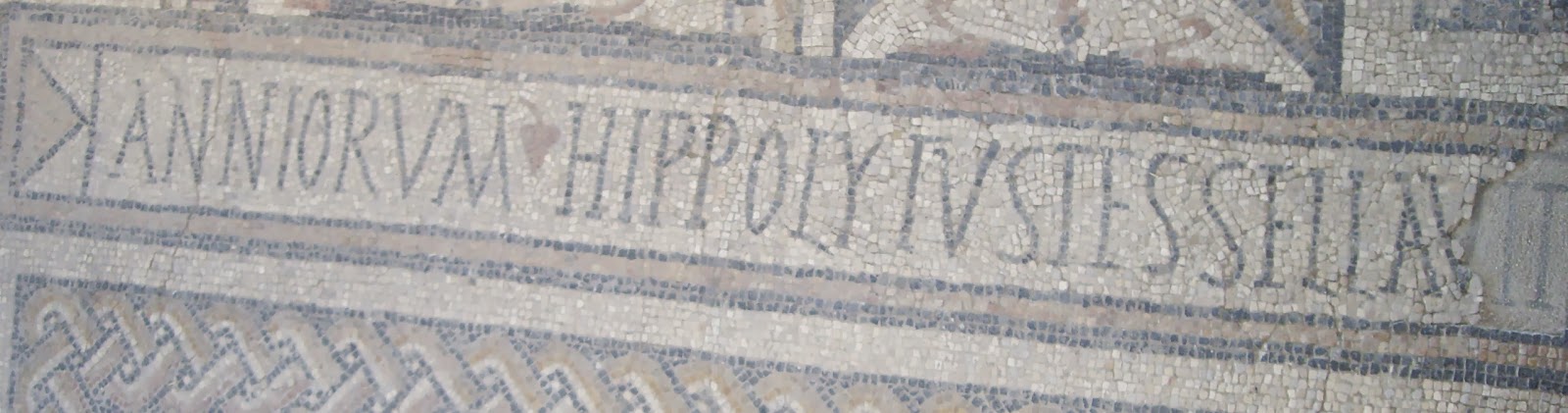
ANNIORUM HYPPOLYTUS TESSELLAVIT
Hyppolitus  lo hizo para los Annios
Hyppolytus made it for the Annios


 Este colegio de jóvenes se encontraba a las afueras de la ciudad pero muy cerca del foro romano, en este colegio los alumnos recibían las enseñanzas clásicas como   griego, historia, dialéctica ,oratoria  ,latín,en definitiva se les daba una educación para que en el futuro ocuparan cargos públicos importantes.Las clases eran impartidas por maestros griegos que gozaban de una gran reputación.

This school of young people was located outside the city but very close to the Roman forum, at this school the pupils got taught about the classic teaching such as , Greek, History, Dialectics, Oratory,Latin ,basically they received an education so as to occupy important public positions in future.The classes were taught by Greek teachers who had a great reputation.

Recreación de la Complutum imperial y el colegio situado a las afueras de la ciudad
Recreation of the Imperial Complutum and the school outside the city

El mosaico del patio central es un pieza de gran valor ,por un lado podemos apreciar unos muchachos , en alusión a los alumnos del colegio, que están pescando con unas redes , por otro lado ,podemos observar la rica fauna marina del Mediterráneo, como pulpos, doradas, lubinas, langostas , langostinos e incluso la temible morena .Hyppolitus vino del norte de África expresamente para realizar este mosaico por encargo de la familia Ania.

The mosaic of the central yard is a piece of great value , on one hand we can see some kids ,an allusion to the pupils of the school, fishing with some nets , on the other hand, we can see the rich Mediterranean marine fauna , such as octopuses, doradas,basses,lobsters, prawns and also the frightening morey.Hyppolitus came on purpose from Northern Africa to make this mosaic for the Ania family.


El Mosaico de Hyppolytus
Hyppolytus' mosaic 


Este colegio tenía varias estancias ,destacan la zonas de baños con la piscina de agua fría trilobulada ,la zona de agua templada y caliente y las letrinas .

This school had several rooms ,especially remarkable is the area of baths with the three-lobe cold water pool, the areas of warm and hot waters and the latrines.


Piscina trilobulada de agua fría
Tri-lobe cold water  pool 
Uno de los elementos más importantes eran la exedras, una especie de bancos semicirculares en el jardín donde se impartían clases o se celebraban comidas comunales, cabían alrededor de 80 alumnos, por los restos que se han encontrado, el jardín tenía una profusa vegetación ,jazmines, tilos, olmos ,palmas e incluso cedros del Líbano.

One of the most important elements were the exedras, a kind of semicircular benches in the garden where communal meals or classes took place, there was  room for 80 pupils , by the remains found the garden had an exhuberant vegatation, jazmins, lime trees,elm trees,palm trees and also cedars from Lebanon.

El jardín con la exedras
The grarden with the exedras 

A nivel arquitectónico destaca una técnica de aislamiento basada en piezas de barro en forma de medias botellas huecas que se ensamblaban entre si.

At the  architectural level stands out an insulation technique based on clay pieces with the shape of empty bottles which were assembled together.

Bóveda con tubos de arcilla
Dome of clay tubes

Una de la estancias más curiosas son las letrinas ,tenían pavimento de mosaico y un canal perimetral por donde se eliminaban las aguas fecales .

One of the most curious rooms is the latrine, it had a mosaic floor and  a perimetral canal to dispose the fecal waters.

Las letrinas
The latrines

No lejos de la casa de Hippolitus podemos ver las ruinas de la antigua ciudad de Cumplutum ,donde todavía pueden verse las plantas varias casa patricias, las termas , la curia ,la plaza del foro y el mercado.Merece la pena visitar las ruinas , en una de las casas nobles se encontró un mosaico del siglo IV que hace alusión al mito del adulterio entre Júpiter y Leda ,podemos leer claramente  en el mosaico "ADULTERIUM IOVIS LEDA ".El mosaico se encuentra en el museo regional de Alcalá de Henares.
Júpiter aparece como un cisne ya que ,según cuenta la mitología griega aprovechó para transformase en esa ave cuando Leda se disponía a tomar el baño.

Not far from the House of Hyppolytus we can see the ruins of the old imperial city of Cumplutum where we can still see today the floor of several Patrician houses, the thermae ,the Curia ,the Forum and the Market.It's worh while to visit the ruins, in one of the noble houses a mosaic from the 4th century was found ,this mosaic makes an allusion to the myth of the adultery between Jupiter and Leda , we  can clearly   read on the mosiac in Latin "ADULTERIUM IOVIS LEDA ".The mosaic is kept at the regional museum of Alcalá de Henares .
Jupiter appears under the shape of a swam ,as the Greek mytholgy says , Jupiter transformed himself into that bird when Leda was going to take the bath.


jueves, 4 de agosto de 2011

La Higiene en el Imperio - Hygiene in the Empire


La higiene personal y pública (saneamientos ,cloacas, colectores ) era algo muy importante en el Imperio, el gran desarrollo de la ingeniería civil permitió la construcción de redes de canalización de aguas sucias y limpias.Aún hoy en dia utilizamos arquetas , colectores ,cloacas ,tuberías como hacían los romanos hace 2000 años. La Edad Media supuso una gran regresión en la higiene ,la falta de la misma favoreció las plagas que diezmaron la población en Europa en varias ocasiones como ocurrió con la Peste Negra.

The personal and public hygiene ( plumbing, sewers,drains ) was very important in the Empire , the great development of the civil engineering allowed the construction of networks of canalization of clean and dirty waters .Even today we use manholes ,drains ,pipes as the romans did 2000 years ago.The Middle Ages involved a regression in hygiene , the lack of the latter favored the plagues that decimated the population in Europe on many ocassions as it happened with the Black Death.

Las letrinas públicas


Las letrinas eran lugares donde los ciudadanos podían hacer sus necesidades, el orín era reutilizado para curtir el cuero y blanquear telas , por eso había un canal que se puede apreciar en las imagenes ,este canal llevaba el orín a un contenedor .

The public latrines

Latrines were places where the citizens relieved themselves ,the urine was recycled to tan the leather and whiten the cloths , for that reason there was a canal as the photos show taking the urine to a container.

Las Termas

Para los romanos las termas no eran sólo un lugar para la higiene personal sino también un lugar de socialización donde se podía comer, hacer deporte , escuchar música ,etc.
Disponían de varias habiraciones con agua caliente, templada y fría .También había vestuarios ,gimnasio y tiendas en el exterior del edificio

The Baths

For the Romans the baths were not only a place for the personal hygiene but also a place of socialization where people could eat ,making sports ,listening to music and so long.
They had several rooms with hot,warm and cold water.There were also changing rooms, a gym and shops outside the building.

Piscina de las termas de Zaragoza
Swimming pool at the Zaragoza baths


El aseo personal

Los romanos no utilizaban el jabón, frotaban su cuerpo con aceite perfumado y poteriormente lo retiraban con ayuda de un instrumento llamado estrigilo, era un raspador en forma curva que arrastraba el polvo y las células muertas de la piel.Cuando los romanos acudían a las termas solian levar colgado al cuello el estrigilo y una bottelita de aceite (ver photo a la derecha).

The personal hygiene

The Romans didn't use soap, they rubbed their bodies with parfumed oil and later they took it away by means of a device called strigilo , it was a kind of bent scraper that carried away the dust and the dead cells of the skin.When the Romans went to the baths they used to take with them , hanging from the neck, the strigilo and a little bottle of oil (see photo on the right).


Utilizaban toallas de algodón y esponjas marinas que traían consigo a las termas .
They used cotton towels and marine sponges that brought with them to the baths.

Cloacas y canalización del agua potable


Para la canalización del agua potable los romanos utilizaban el plomo, hoy en día nocivo para la salud, sin embargo el plomo se ha utilizado en las cañerias hasta no hace muchos años.

Los romanos fabricaban planchas de plomo que doblaban con la ayuda de cilindros de madera , posteriormente unían los bordes con plomo fundido, para unir las tuberías utilizaban una piezas cuadradas de plomo sobre las que vertían plomo fundido para hacer las uniones estancas.

Sewers and canalization of drinkable water

For the canalization of drinkable water the Romans used plumb, today it is considered to be harmful for health, however it has been used in pipes till not many years ago.

The  Romans made sheets of plumb that bent with the help of wooden cilinders ,later on they joined the edges with melted plumb, to join the pipes they used squared pieces to which they poured melted plumb to have the joints sealed .

Las aguas residuales circulaban por las cloacas , en España existen algunas cloacas de gran caudal como la  de Cesaraugusta (Zaragoza).

The residual waters went through the sewers , in Spain there are several sewers with big flow volume as the one of Cesaraugusta (Zaragoza).


Debajo puede verse una foto de la cloaca máxima de Cesaraugusta que discurría por debajo del foro, hoy en día la Plaza del Pilar .

Below there is a photo of the great sewer of Cesaraugusta that went thorugh under the forum , today The Pilar Square .


Dabajo se aprecia una imagen de la cloaca de Itálica .
Below there is an image of the sewer of Itálica.