

domingo, 4 de noviembre de 2018

miércoles, 17 de mayo de 2017
Mi coleccion de monedas romanas - My collection of Roman coins

Hacer click en los enlaces de abajo para acceder a información sobre monedas romanas de mi colección .
Click on the links below to get access to information of Roman coins of my collection
Los cinco emperadores buenos - The five good emperors
Cuadrante Claudio - Claudius quadrans
Itinerario Antonino denari
Máximo el hispano usurpador
Caracalla y Geta ,Cain y Abel
Peinados y monedas romanas
martes, 24 de diciembre de 2013
Falcata contra Gladio - Falcata vs Gladium
Carabias es un pequeño pueblo de la provincia de Guadalajara con una de las iglesias románicas más interesantes de toda Castilla.
 A principios del pasado siglo el Marqués de Cerralbo encontró en Carabias una necrópolis ibérica del siglo IV antes de Cristo, esta necrópolis ha desaparecido hoy , ya que las gentes del campo iban amontonando las piedras a medida que se las encontraban cada vez que araban la tierra.Se encontraron varias tumbas ,el hallazgo más interesante fue una falcata ibérica que se encuentra en el Museo Arqueológico Nacional.
La falcata fué una de las armas más temibles de la antigüedad y su oponente fue el gladio romano, un arma más ligera que permitía mantener una mayor distancia con el adversario al ser un poco más larga , a continuación se puede ver una comparativa entre ambas espadas .
Carabias is a small village in the province of Guadalajara ,it has one of the most interesting churches of Romanesque style in the entire Castile.
At the beginning of the last century Marquis of Cerralbo found in Carabias an Iberian necropolis from the IV century b.c., this necropolis has disappeared since the peasants were piling up the stones they found when ploughing the land .Several tombs were found , the most interesting finding was an Iberian falcata which is kept at the National Museum of Archaeology .
The falcata was one of the most terrifying weapons of the ancient world and its opponent was the Roman gladium a lighter weapon which allowed to have a bigger distance with the adversary as it was a bit longer, herebelow you can find a comparison between both swords
Falcata

Gladium

 A principios del pasado siglo el Marqués de Cerralbo encontró en Carabias una necrópolis ibérica del siglo IV antes de Cristo, esta necrópolis ha desaparecido hoy , ya que las gentes del campo iban amontonando las piedras a medida que se las encontraban cada vez que araban la tierra.Se encontraron varias tumbas ,el hallazgo más interesante fue una falcata ibérica que se encuentra en el Museo Arqueológico Nacional.
La falcata fué una de las armas más temibles de la antigüedad y su oponente fue el gladio romano, un arma más ligera que permitía mantener una mayor distancia con el adversario al ser un poco más larga , a continuación se puede ver una comparativa entre ambas espadas .
 | |||||
| Falcata ibérica de la necrópolis del Tesoro en Carabias Iberian falcata from the Necropolis El Tesoro in Carabias |
Carabias is a small village in the province of Guadalajara ,it has one of the most interesting churches of Romanesque style in the entire Castile.
At the beginning of the last century Marquis of Cerralbo found in Carabias an Iberian necropolis from the IV century b.c., this necropolis has disappeared since the peasants were piling up the stones they found when ploughing the land .Several tombs were found , the most interesting finding was an Iberian falcata which is kept at the National Museum of Archaeology .
The falcata was one of the most terrifying weapons of the ancient world and its opponent was the Roman gladium a lighter weapon which allowed to have a bigger distance with the adversary as it was a bit longer, herebelow you can find a comparison between both swords
Falcata

- Espada ibérica corta entre 42 y 55 cm forjada en caliente con 3 láminas de hierro , a las que se habían sometido a un proceso de oxidación para eliminar las impurezas .La hoja central se prolongaba sobre las otras para crear el mando que terminaba en una cabeza de caballo o águila
- Tenía un solo filo y unas acanaladuras a los lados que introducían aire en las heridas para causar un gran daño.
- La estructura de la funda era también de hierro y se cubría con cuero o madera
- La espada de un guerrero era considerada divina y normalmente se inutilizaba cuando éste moría
- Iberian short sword between 42 and 55 cms hot forged with three iron blades which had been gone thru an oxidation process so as to eliminate impurities.The central blade was prolonged over the others to hold the handle made with wood or bone,it had at the end a head of a horse or hawk.
- It had one cutting edge and some grooves on both sides so as to introduce air in the wounds to create great damage .
- The frame of the cover was made in iron covered with wood or leather.
- The sword was considered sacred and it was destroyed when he died or was killed.
Gladium

- Espada romana de hasta 60 y 70 cm.
- Tenía dos filos y estaba diseñada para perforar.
- Era una espada más ligera
- Tenía un pomo en el mango para equilibrar el peso de la hoja
- Roman sword sword up to 60 to 70 cm
- It had two cutting edges and was designed to penetrate
- It was a lighter sword
- It had a knob at the handle to balance the weight of the blade
domingo, 22 de septiembre de 2013
La Casa de Hyppolytus de Alcalá de Henares-The House of Hyppolytus in Alcalá de Henares
 |
| Vista general del yacimeinto General view of the site |
 En el siglo I de nuestra era , una poderosa e influyente familia de Complutum ,Los Anios , patrocina la construcción de un colegio privado para hijos de familias acomodadas;en este colegio ,collegium iuvemum, los jóvenes de familias pudientes se formaban para algún día poder acceder a cargos políticos importantes en la ciudad (ediles, magistrados,etc ).
El nombre de la Casa de Hyppolytus proviene de un artista que realizó un mosaico de gran belleza que veremos después , en este mosaico aparece un texto en latín con su nombre .
On the 1st century of our era ,a powerful and influential family of Complutum, The Anios , sponsors the construction of a private school for the children of rich families; in this school, collegium iuvenum ,the young children of powerful families were educated to become leaders in the city (magistrates, councilmen,etc).
The name of the House of Hyppolytus comes from the artist of a great-beauty mosaic that we will see later on, on this mosaic there is a text in Latin with its name .
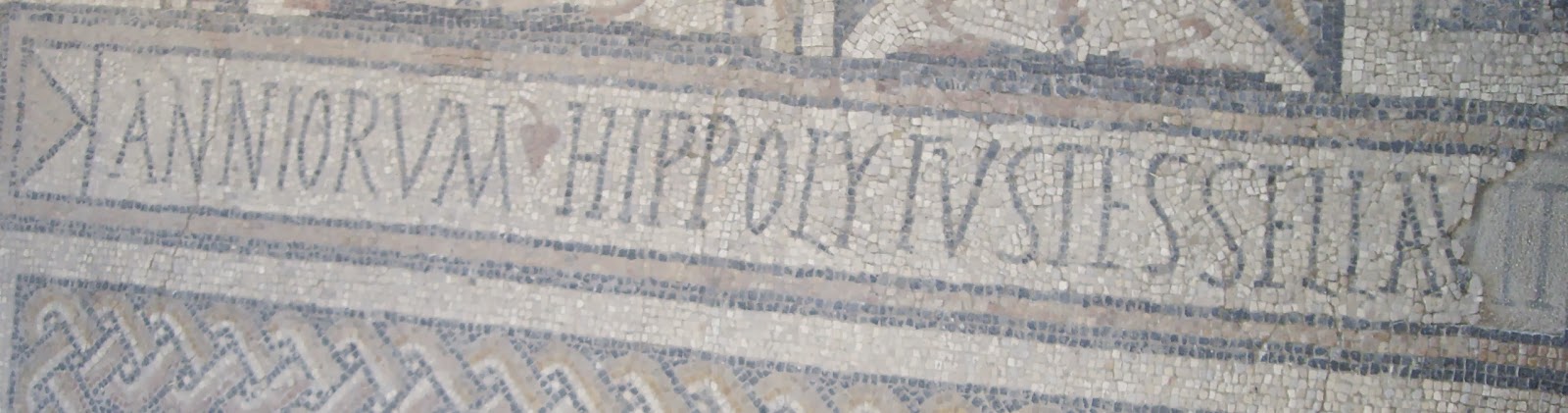 |
| ANNIORUM HYPPOLYTUS TESSELLAVIT Hyppolitus lo hizo para los Annios Hyppolytus made it for the Annios |
This school of young people was located outside the city but very close to the Roman forum, at this school the pupils got taught about the classic teaching such as , Greek, History, Dialectics, Oratory,Latin ,basically they received an education so as to occupy important public positions in future.The classes were taught by Greek teachers who had a great reputation.
 |
| Recreación de la Complutum imperial y el colegio situado a las afueras de la ciudad Recreation of the Imperial Complutum and the school outside the city |
The mosaic of the central yard is a piece of great value , on one hand we can see some kids ,an allusion to the pupils of the school, fishing with some nets , on the other hand, we can see the rich Mediterranean marine fauna , such as octopuses, doradas,basses,lobsters, prawns and also the frightening morey.Hyppolitus came on purpose from Northern Africa to make this mosaic for the Ania family.
 |
| El Mosaico de Hyppolytus Hyppolytus' mosaic |
Este colegio tenía varias estancias ,destacan la zonas de baños con la piscina de agua fría trilobulada ,la zona de agua templada y caliente y las letrinas .
This school had several rooms ,especially remarkable is the area of baths with the three-lobe cold water pool, the areas of warm and hot waters and the latrines.
 |
| Piscina trilobulada de agua fría Tri-lobe cold water pool |
One of the most important elements were the exedras, a kind of semicircular benches in the garden where communal meals or classes took place, there was room for 80 pupils , by the remains found the garden had an exhuberant vegatation, jazmins, lime trees,elm trees,palm trees and also cedars from Lebanon.
 |
| El jardín con la exedras The grarden with the exedras |
A nivel arquitectónico destaca una técnica de aislamiento basada en piezas de barro en forma de medias botellas huecas que se ensamblaban entre si.
At the architectural level stands out an insulation technique based on clay pieces with the shape of empty bottles which were assembled together.
 |
| Bóveda con tubos de arcilla Dome of clay tubes |
Una de la estancias más curiosas son las letrinas ,tenían pavimento de mosaico y un canal perimetral por donde se eliminaban las aguas fecales .
One of the most curious rooms is the latrine, it had a mosaic floor and a perimetral canal to dispose the fecal waters.
 |
| Las letrinas The latrines |
No lejos de la casa de Hippolitus podemos ver las ruinas de la antigua ciudad de Cumplutum ,donde todavía pueden verse las plantas varias casa patricias, las termas , la curia ,la plaza del foro y el mercado.Merece la pena visitar las ruinas , en una de las casas nobles se encontró un mosaico del siglo IV que hace alusión al mito del adulterio entre Júpiter y Leda ,podemos leer claramente en el mosaico "ADULTERIUM IOVIS LEDA ".El mosaico se encuentra en el museo regional de Alcalá de Henares.
Júpiter aparece como un cisne ya que ,según cuenta la mitología griega aprovechó para transformase en esa ave cuando Leda se disponía a tomar el baño.
Not far from the House of Hyppolytus we can see the ruins of the old imperial city of Cumplutum where we can still see today the floor of several Patrician houses, the thermae ,the Curia ,the Forum and the Market.It's worh while to visit the ruins, in one of the noble houses a mosaic from the 4th century was found ,this mosaic makes an allusion to the myth of the adultery between Jupiter and Leda , we can clearly read on the mosiac in Latin "ADULTERIUM IOVIS LEDA ".The mosaic is kept at the regional museum of Alcalá de Henares .
Jupiter appears under the shape of a swam ,as the Greek mytholgy says , Jupiter transformed himself into that bird when Leda was going to take the bath.

jueves, 1 de agosto de 2013
La necrópolis romana de Yunquera de Henares-The Roman necropolis of Yunquera de Henares

Yunquera de Henares , Iuncaria (tierra de juncos) ,se encuentra muy cerca del antiguo trazado de la vía romana que unía Cesaragusta con Emérita Augusta.
Hace aproximadamente cinco años que se encontró una necrópolis romana con unas 70 sepulturas , en estas tumbas se han hallado varios objetos que nos ayudan a conocer en que época se utilizaron.Han aparecido monedas de la Época de Marco Aurelio ,siglo II , y también monedas del siglo IV.Eran las monedas que se depositaban en la boca del difunto para pagar la barca de Caronte que les llevaba al Más Allá.
Las tumbas reflejan el estatus económico de las familias ya que aparecen tumbas muy elaboradas con sillares de piedra muy regulares y otras, en cambio, son simples enterramientos muy sencillos.
En el siguiente enlace se puede descargar el estudio realizado por los arqueólogos Jorge Morín de Pablos ,Ernesto Agustí y Pablo Guerra García .En este documento hay información muy interesante sobre los objetos hallados y la datación histórica del yacimiento.
 |
| Tumba con sillares de piedra Tomb with regular stones |
 |
| Tumba sencilla Simple tomb |
Yunquera de Henares , Iuncaria (land of reeds), it is located very close to the ancient route of the Roman road that linked Cesaraugusta with Emerita Augusta .It was approximately 5 years ago that a Roman necropolis with 70 tombs was found ,several objects have been found in those tombs that help us know when they were used.Coins from the times of Macus Aurelius (2nd century a.c.) and also some from the 4th century have been found.These were the coins that were placed inside the mounth of the dead people in order to pay Charon's passage that took them to the Great Beyond.
The tombs reflect the economical status of the families since there are very much worked tombs with regular stones and others,on the contrary,are very plain burials .
In the following link ,the study made by the archaeologists Jorge Morín de Pablos ,Ernesto Agustí and Pablo Guerra García can be downloaded.In this document very interesting information can be found about the findings and the date of the site.
lunes, 29 de julio de 2013
La Guerra de Sertorio en Guadalajara-Sertorius' War in Guadalajara
La guerra de Sertorio se inicia en el año 83 a. J.C.,Cayo Mario y Quinto Sertorio desafían al poder de Roma y la cruel dictadura de Sila .Este conflicto dura 11 años .El conflicto de desarrolla principalmente en Hispania y la provincia de Guadalajara es testigo de estos combates.
En Alarilla ,en las cercanías de Tórtola y en Alcocer se han hallado proyectiles de plomo con leyendas alusivas a Sertorio.
Debajo puede encontrarse un enlace con un trabajo realizado por el historiador de la Universidad Complutense de Madrid ,Emilio Gamo Pazos , que aporta pruebas de que Guadalajara fue testigo de enfrentamientos entre las dos facciones.
Roma no consigue derrotar a Sertorio y envía a Pompeyo al mando de 50.000 hombres y 1.500 jinetes, en un principio las tropas de Sertorio consiguen derrotar a Pompeyo gracias a la ayuda de los pueblos celtiberos y al gran conocimiento del terreno que tenían las tropas del primero.
Pompeyo incia una represión a sangre y fuego, debajo pueden verse unas fotografías de soldados partidarios de Sertorio que fueron ejecutados de forma cruel en la ciudad de Valentia (Valencia).
El conflicto acaba en el año 72 con la muerte de Sertorio a manos de un grupo de traidores .
The war of Sertorius starts in the year 83 B.C, Caius Marius and Sertorius defy the power of Rome and the cruel dictatorship of Sila.This conflicto last 11 years .The conflict takes place mainly in Hispania and the province of Guadalajra is a witness of those combats.
In Alarilla , near Taracena and Alcocer some lead projectile with legends alusive to Serorius have been found .
Below there is a link to a study made by the historian of the University Complutense ,Emilio Gamo Pazos , which gives proofs that Guadalajara was a witness of the combats between the two factions.
Rome does not succeed in defeating Sertorius ans sends Pompeius in front of 50,000 men and 1.500 horsemen, at the beginning Sertorius troops beat Pompeius thanks to their well knowdledge of the area.
Pompeius starts a repression by fire and sword,below there are some images of soldiers of Sertorius that were executed in a cruel way in the city of Valentia (Valencia).
The conflict ends in the year 72 B.C. with the death of Sertorius at the hands of traitors.
En Alarilla ,en las cercanías de Tórtola y en Alcocer se han hallado proyectiles de plomo con leyendas alusivas a Sertorio.
Debajo puede encontrarse un enlace con un trabajo realizado por el historiador de la Universidad Complutense de Madrid ,Emilio Gamo Pazos , que aporta pruebas de que Guadalajara fue testigo de enfrentamientos entre las dos facciones.
Roma no consigue derrotar a Sertorio y envía a Pompeyo al mando de 50.000 hombres y 1.500 jinetes, en un principio las tropas de Sertorio consiguen derrotar a Pompeyo gracias a la ayuda de los pueblos celtiberos y al gran conocimiento del terreno que tenían las tropas del primero.
Pompeyo incia una represión a sangre y fuego, debajo pueden verse unas fotografías de soldados partidarios de Sertorio que fueron ejecutados de forma cruel en la ciudad de Valentia (Valencia).
El conflicto acaba en el año 72 con la muerte de Sertorio a manos de un grupo de traidores .
 |
| Patidario de Sertorio atravesado por un pilum en Valentia Supporter of Sertotius pierced by a pilum in Valentia |
 |
| Partidario de Sertorio al que cercenaron las piernas en Valentia Supporter of Sertorius whose legs were hacked off in Valentia |
The war of Sertorius starts in the year 83 B.C, Caius Marius and Sertorius defy the power of Rome and the cruel dictatorship of Sila.This conflicto last 11 years .The conflict takes place mainly in Hispania and the province of Guadalajra is a witness of those combats.
In Alarilla , near Taracena and Alcocer some lead projectile with legends alusive to Serorius have been found .
Below there is a link to a study made by the historian of the University Complutense ,Emilio Gamo Pazos , which gives proofs that Guadalajara was a witness of the combats between the two factions.
Rome does not succeed in defeating Sertorius ans sends Pompeius in front of 50,000 men and 1.500 horsemen, at the beginning Sertorius troops beat Pompeius thanks to their well knowdledge of the area.
Pompeius starts a repression by fire and sword,below there are some images of soldiers of Sertorius that were executed in a cruel way in the city of Valentia (Valencia).
The conflict ends in the year 72 B.C. with the death of Sertorius at the hands of traitors.
sábado, 20 de julio de 2013
Estatuilla de Marte en el museo provincial de Guadalajara-Little statue of Mars at the Provincial Museum in Guadalajara

El museo provincial de Guadalajara guarda una pieza muy interesante de la época romana, es una estatuilla de bronce del dios Marte, fue un hallazgo casual que se encontró en Bujalaro muy cerca de la calzada romana que discurría por las inmediaciones y que unía Emerita Augusta con Cesaragusta.
Esta estatuilla de la que solo se conserva la cabeza con el típico yelmo encrestado,pertenecía con toda seguridad a un lararium , una pequeña capilla en las domus romanas que albergaba estas estatuillas de los dioses protectores del hogar y donde se hacían ofrendas
Emilio Gamo Pazos del Dto. de Prehistoria e Historia Antigua de la Universidad Complutense de Madrid ha hecho un estudio de la pieza que se puede ver y descargar en el siguiente enlace .
The provincial museum of Guadalajara displays a very interesting piece from the Roman Era , it is a small bronze statue, it was a casual finding in Bujalaro very close to the Roman Road nearby that linked Emerita Augusta and Zaragoza
This small statue that keeps only the head with the typical crested helmet , corresponds to a larrarium which was a little chapel in the Roman domus which kept these statues of the home protective gods and where offerings were made..
Emilio Gamo Pazos of the History and Prehisory Department of the Complutense University in Madrid has made a brief study which can be seen and download by clicking on the link below
En la imagen de bajo puede apreciarse un lararium de una casa romana donde se veneraban estas estatuillas
On the image below a lararrium of a typical Roman house can be seen .

martes, 14 de mayo de 2013
jueves, 28 de febrero de 2013
domingo, 20 de enero de 2013
Vestigios romanos en Atienza y sus alrededores-Roman remains in Atienza and sorroundings
Las tierras de Atienza fueron ocupadas por los arevacos, pueblos que ofrecieron una fuerte resistencia a los romanos; una vez que estas tierras fueron romanizadas se construyeron vías romanas y se iniciaron asentamientos, se construyeron fuentes ,villas ,termas,etc.De está época romana se han encontrado algunos restos como los que se detallan a continuación:
The lands of Atienza were occupied by the Arevacs, people that offered a great resistance against the Romans ;once this land was romanized ,they built Roman roads and settlements started with villas, fountains ,themae, and so on.From this time some remains were found like the ones mentioned below:
Miedes de Atienza
En el paraje de la ermita de la Virgen fueron encontrados un vaso de vidrio para ceremonias y un amuleto en forma de falo muy bien detallado en posición eréctil con testículos y el glande descubierto.
Miedes de Atienza
In the place called Ermita de La Virgen a glass for ceremonies and a phallic amulet well detailed in erection with testicles and an uncovered glans were found.
Los amuletos fálicos los portaban los niños y niñas ,no solo como deseo de una buena fecundidad en el futuro sino también para ahuyentar "el mal de ojo" o la mala suerte.
The phallic amulets were worn by boys and girls alike, not only as a wish of good fertility in future but also to drive away bad luck.
Atienza
A la salida de la iglesia de San Bartolomé por la puerta norte del atrio se encuentra una fuente romana del siglo II.Tiene sillares muy bien labrados y regulares .
Atienza
In the way out thru the North gate of San Bartolomé's church there is Roman fountain from the 2nd century.It has regular and well worked pieces of stones.

The lands of Atienza were occupied by the Arevacs, people that offered a great resistance against the Romans ;once this land was romanized ,they built Roman roads and settlements started with villas, fountains ,themae, and so on.From this time some remains were found like the ones mentioned below:
Miedes de Atienza
En el paraje de la ermita de la Virgen fueron encontrados un vaso de vidrio para ceremonias y un amuleto en forma de falo muy bien detallado en posición eréctil con testículos y el glande descubierto.
Miedes de Atienza
In the place called Ermita de La Virgen a glass for ceremonies and a phallic amulet well detailed in erection with testicles and an uncovered glans were found.
 |
| Vaso de vidrio romano ,museo de San Bartolomé en Atienza Roman vitrium glass, San Bertolomé's museum in Atienza |
 |
| Amuleto fálico,museo de San Bartolomé en Atienza Phallic amulet ,San Bartolomé's museum in Atienza
|
The phallic amulets were worn by boys and girls alike, not only as a wish of good fertility in future but also to drive away bad luck.
Atienza
A la salida de la iglesia de San Bartolomé por la puerta norte del atrio se encuentra una fuente romana del siglo II.Tiene sillares muy bien labrados y regulares .
Atienza
In the way out thru the North gate of San Bartolomé's church there is Roman fountain from the 2nd century.It has regular and well worked pieces of stones.

martes, 6 de noviembre de 2012
jueves, 26 de julio de 2012
La Minerva de Pelegrina

Poca gente conoce que allá por el año 1895 apareció un bronce de la época romana de la diosa Minerva en Pelegrina , a 5 kms. de Sigüenza.
Es un bronce de 65 cms de altura ; la estatua tiene un bonito drapeado y le falta la cabeza, el brazo izquierdo y parte del brazo derecho.Alrededor del cuello de Minerva pueden apreciarse las dos serpientes enroscadas que eran simbolo de sabiduría y curación.
Minerva era la diosa de la Sabiduría ,las Artes , las técnicas de guerra y además era la protectora de Roma y la patrona de los artesanos.
Esta estatua acabó en las manos de por aquel entonces obispo de Sigüenza , D.Antonio Ochoa quien la donó al Museo Arqueologico Nacional sito en Madrid.
Esta estatua debería ser devuelta a Guadalajara y albergada en su Museo Provincial.
martes, 8 de mayo de 2012
Cuadrante del emperador Claudio-Cuadrans of Emperor Claudius
Los que tenemos cierta edad y nos gusta la historia de Roma recordamos con gran viveza la cautivadora serie de la BBC de 1976 , Yo Claudio.Esta serie ,basada en la novela de Robert Graves ,nos retrataba las intrigas de la corte imperial de Roma .Nos acordamos de Livia ,la viuda del emperador Augusto ,sus intrigas acabaron con muchos pretendientes al trono.
Esta serie estaba interpretada por el magnifico actor Derek Jacobi ,su interpretación del tartamudo y lisiado Claudio a causa de una poliomielitis infantil fue magnifica.
El emperador Claudio fue el 4º emperador después de Augusto,Tiberio y el infame Caligula ,era un tecnocráta ,su hecho más destacado fue la conquista de Britania y la reforma del sistema de pesos de las diferentes monedas (Pondus Nummi Restitutum) . Su tercera mujer fue Mesalina , la más grande ninfomana de la época.
La moneda que se muestra abajo es un cuadrante , era la moneda de menos valor hecha de cobre.
Those of us with a certain age and lovings of the Roman history remember vividly the captivating 1976 BBC series I, Claudius.This series was based on the novel by Robert Graves ,it showed the intrigues of the Imperial Roman Court .We remember Livia ,the vidow of Emperor Augustus, her intrigues ended up with the death of several pretenders to the throne .
This series was characterized by the superb actor Derek Jacobi, his interpretation of the stammerer and disabled Claudius ,due to an infant pliomielithis , was splendid.
Emperor Claudius was the fourth emperor after Augustus, Tiberius and the infamous Caligula, he was a paragmatic , he is famous by the conquer of Britain and the reform of the weights of the monetary system (Pondus Nummi Restitutum) .His third wife was Messalina , the biggest nymphomaniac at the time.
The coin shown below is a quadrans ,was the less valuable copper coin .
Esta serie estaba interpretada por el magnifico actor Derek Jacobi ,su interpretación del tartamudo y lisiado Claudio a causa de una poliomielitis infantil fue magnifica.
El emperador Claudio fue el 4º emperador después de Augusto,Tiberio y el infame Caligula ,era un tecnocráta ,su hecho más destacado fue la conquista de Britania y la reforma del sistema de pesos de las diferentes monedas (Pondus Nummi Restitutum) . Su tercera mujer fue Mesalina , la más grande ninfomana de la época.
La moneda que se muestra abajo es un cuadrante , era la moneda de menos valor hecha de cobre.
 |
| Anverso:Mano que sostiene una balanza.Debajo PNR (Pondus Nummi Restitutum) TI CLAVDIVS CAESAR AVG Obverse :Hand holding scales .Below PNR (Pondus Nummi Restitutum) TI CLAVDIVS CAESAR AVG Reverso: PONT M TR P IMP COS DESIT en el centro SC (Senatus Consulto) Reverse:PONT M TR P IMP COS DESIT in the centre SC (Senatus Consulto) Colección/Collection - Alfonso López |
This series was characterized by the superb actor Derek Jacobi, his interpretation of the stammerer and disabled Claudius ,due to an infant pliomielithis , was splendid.
Emperor Claudius was the fourth emperor after Augustus, Tiberius and the infamous Caligula, he was a paragmatic , he is famous by the conquer of Britain and the reform of the weights of the monetary system (Pondus Nummi Restitutum) .His third wife was Messalina , the biggest nymphomaniac at the time.
The coin shown below is a quadrans ,was the less valuable copper coin .
viernes, 27 de abril de 2012
La cupa de Alovera (Guadalajara)- The cupa of Alovera (Guadalajara)
En el verano de 1999 durante unas obras que se realizaban en la cimentación de la torre de la Iglesia de Alovera apareció una piedra extraña con una inscripción en latín .D.Pedro García , el párroco de Alovera, sospechó que podría tratarse de un vestigio de la época romana.Esta piedra que resultó ser un monumento funerario del siglo I ó II d. JC , fue cedida posterioremente al ayuntamiento donde se custodia en la sala de juntas.Ana Isabel López , licenciada en Historia y archivera del ayuntamiento la enseña amablemente a todo aquel interesado en ver esta pieza tan singular.
In the summer of 1999 while some works were being performed in the foundations of the tower of the church in Alovera a stone with an inscription in latin was found.Don Pedro García ,the vicar of Alovera ,thought it could be a remain from the Roman times. This stone, that turned to be a funerary monument from the 1st or 2nd century after Christ, was handed over to the Town Hall where it is kept now in the boardroom. Ana Isabel López ,graduated in History and the archivist of the town hall kindly shows it to anyone interested in seeing such a peculiar stone.


A cupa is a funerary monument erected to remember the deceased buried below ,these monuments were normally located on the sides of the roads out of villages and towns as the Roman law demanded.The word cupa comes from the latin capere (contain) since the monument resembles a barrel.
The dimensions of this cupa are 57cms high, 40 cms wide and 80 cms deep.On the upper part there is a hole where a focus was introduced to make sacrifices.The historians Juan Manuel Abascal and Armin Stylow from the University of Alcalá de Henares have studied the inscription of this cupa , the latter proposes the following text :

In the summer of 1999 while some works were being performed in the foundations of the tower of the church in Alovera a stone with an inscription in latin was found.Don Pedro García ,the vicar of Alovera ,thought it could be a remain from the Roman times. This stone, that turned to be a funerary monument from the 1st or 2nd century after Christ, was handed over to the Town Hall where it is kept now in the boardroom. Ana Isabel López ,graduated in History and the archivist of the town hall kindly shows it to anyone interested in seeing such a peculiar stone.


Una cupa es un monumento funerario erigido para recordar al difunto que estaba enterrado debajo ,estos monumentos se encontraban normalmente a la vera de los caminos fuera de las villas y ciudades romanas como exigía la ley .La palabra cupa procede del latín capere (caber) ya que el monumento recuerda a un barril.
Las dimensiones de esta cupa son 57 cms de alto por 40 cms de ancho y 80 cms de fondo.Por la parte superior tiene un agujero por el que se introducía un focus de bronce para realizar sacrificios . Los historiadores Juan Manuel Abascal Palazón and Armin Stylow de la Universidad de Alcalá de Henares han estudiado la inscripción de esta cupa ,éste último propone el siguiente texto :
Pompeio
Fusco · ân(norum) · LX
Nonia
Mellusa
marito f(aciendum) [c(uravit)]
--------
(Monumento a )
Pompeio Fusco de 60 años
Lo levantó a su marido
Antonia Melusa
A cupa is a funerary monument erected to remember the deceased buried below ,these monuments were normally located on the sides of the roads out of villages and towns as the Roman law demanded.The word cupa comes from the latin capere (contain) since the monument resembles a barrel.
The dimensions of this cupa are 57cms high, 40 cms wide and 80 cms deep.On the upper part there is a hole where a focus was introduced to make sacrifices.The historians Juan Manuel Abascal and Armin Stylow from the University of Alcalá de Henares have studied the inscription of this cupa , the latter proposes the following text :
Pompeio
Fusco · ân(norum) · LX
Nonia
Mellusa
marito f(aciendum) [c(uravit)]
--------
(Monument of )
Pompeio Fusco of 60 years
Nonia Mellusa put it up to his husband
Pompeio Fusco of 60 years
Nonia Mellusa put it up to his husband
El apellido Melusa es de origen liberto, posiblemente Pompeio se había casado con su esclava a quien habría liberado previamente .
The surname Mellusa seems to be of liberto origin,Pompeio might married his slave after freeing her previously.
The surname Mellusa seems to be of liberto origin,Pompeio might married his slave after freeing her previously.

En la iglesia de Alovera hay una base de columna que parece de la época romana ,el aspecto de la piedra es muy parecido al de la cupa.Posiblemente proceda del peristilo de la casa de un romano rico.
In the church of Alovera there is a base of a column which looks like to come from the Roman times because the limestone is very similar to the one of the cupa .It might come from the peristylium of a wealthy Roman's house .
In the church of Alovera there is a base of a column which looks like to come from the Roman times because the limestone is very similar to the one of the cupa .It might come from the peristylium of a wealthy Roman's house .
lunes, 9 de abril de 2012
Magno Máximo ,el hispano usurpador .Magnus Maximus ,the hispanic usurper
La historia del imperio romano está llena de usurpadores que ambicionaron el puesto del emperador , en la mayoría de los casos ,estos usurpadores eran generales muy populares a quienes sus tropas proclamaban emperadores, esto fue un hecho común ya que el imperio atravesó por momentos en los que sus tropas, algunas estacionadas muy lejos de Roma, no recibían la paga.
Magno Maximo nació en Hispania en el seno de una familia pobre ,sin embargo llegó a ser comandante de las tropas de Graciano en Britania.En julio del año 383 d. JC ,sus soldados ,descontentos con Graciano ,le nombran emperador. Graciano ,apenas protegido por su guardia personal huyó a Italia pero nunca llegó, ya que fue asesinado por el camino ,en ese momento Máximo se proclama emperador de Britania, Las Galias, Hispania y Africa .Su ambición le ciega ,será su fín, y dirige sus tropas contra Valentianiano II ,en Italia ,Valentiniano contaba sólo con 12 años de edad y era el césar y legítimo sucesor de Graciano, Teodosio el Grande acude a su rescate y derrota a Maximo en la Batalla de Petovio, Maximo sería ejecutado poco después en Aquilea (en la actual frontera con Slovenia ).
The history of the Roman Empire is full of usurpers who ambitioned the position of emperor ,in most of the cases ,these usurpers were very popular generals whom their own troops proclaimed emperors, this was a very common fact since the empire went thru periods on which the troops ,some stationed very far away from Rome, didn´t get the pay.
Magnus Maximus was born in Hispania from a poor family, however he bacame ,commander of Gratianus troops in Britannia.In july 383 after JC,his soldiers unhappied with the emperor Gratianus proclaimed him emperor.Gratianus ,hardly protected by his personal guard fled to Italy, but he never got there since he was assassinated on the way, at that moment Magnus Maximus is proclamed emperor of the Galias, Hispania and Africa.His ambition blinds him,this will be his end,he leads his troops against Valentinian II in Italy ,Valentinian II was only 12 years old and was the caesar and legitime sucessor of Gratianus .Theodosius the Great ,the eastern Roman emperor ,came to his rescue and defeated Magnus Maximus in the battle of Pettovio, Magnus would be later on executed in Aquilea (in the current frontier with Slovenia)
Magno Maximo nació en Hispania en el seno de una familia pobre ,sin embargo llegó a ser comandante de las tropas de Graciano en Britania.En julio del año 383 d. JC ,sus soldados ,descontentos con Graciano ,le nombran emperador. Graciano ,apenas protegido por su guardia personal huyó a Italia pero nunca llegó, ya que fue asesinado por el camino ,en ese momento Máximo se proclama emperador de Britania, Las Galias, Hispania y Africa .Su ambición le ciega ,será su fín, y dirige sus tropas contra Valentianiano II ,en Italia ,Valentiniano contaba sólo con 12 años de edad y era el césar y legítimo sucesor de Graciano, Teodosio el Grande acude a su rescate y derrota a Maximo en la Batalla de Petovio, Maximo sería ejecutado poco después en Aquilea (en la actual frontera con Slovenia ).
The history of the Roman Empire is full of usurpers who ambitioned the position of emperor ,in most of the cases ,these usurpers were very popular generals whom their own troops proclaimed emperors, this was a very common fact since the empire went thru periods on which the troops ,some stationed very far away from Rome, didn´t get the pay.
Magnus Maximus was born in Hispania from a poor family, however he bacame ,commander of Gratianus troops in Britannia.In july 383 after JC,his soldiers unhappied with the emperor Gratianus proclaimed him emperor.Gratianus ,hardly protected by his personal guard fled to Italy, but he never got there since he was assassinated on the way, at that moment Magnus Maximus is proclamed emperor of the Galias, Hispania and Africa.His ambition blinds him,this will be his end,he leads his troops against Valentinian II in Italy ,Valentinian II was only 12 years old and was the caesar and legitime sucessor of Gratianus .Theodosius the Great ,the eastern Roman emperor ,came to his rescue and defeated Magnus Maximus in the battle of Pettovio, Magnus would be later on executed in Aquilea (in the current frontier with Slovenia)
 |
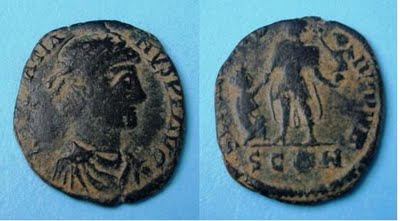
| Moneda de Magnus Maximus Anverso : D N MAG MAXIMUS PF AUG Reverso: REPARATIO REIPB Mujer arrodillada suplicando a Máximo Ceca : Lion (LUGD-Lugdunum) .Colección Alfonso López |
 |
| Moneda del emperador Graciano Anverso : D N GRATIANUS PF AUG Reverso: REPARATIO REIPB Mujer arrodillada suplicando a Graciano Ceca : Lion.Colección Alfonso López |
sábado, 22 de octubre de 2011
Lápidas romanas encontradas en Guadalajara-Roman tombstones found in Guadalajara
Debajo pueden verse dos ejemplos muy diferentes y curiosos de lápidas romanas encontradas en la provincia de Guadalajara.Estas lápidas reflejan el poder adquisitivo de las familias que las mandaron hacer.
Lápida romana de La Riba de Saelices
Esta lápida debió pertenecer a una familia humilde, se encuentra bastante deteriorada, solamente es posible leer la parte que estaba enterrada en la tierra.La lápida corresponde a un varón de 19 años (es visible el nº 19 en caracteres romanos, XIX), el hombre de la persona es ilegible.Aparecen abreviaturas, algo muy común en aquella época con el objeto de economizar el lenguaje y escribir la mayor cantidad de información sobre el muerto en el menor espacio posible.La lápida tiene 78 cms de alto,36 cms de ancho y 18 cms de grosor.Se calcula que esta lápida es del siglo II ó III d. J.C.

La inscripción dice :
(..T) OCI / (...) CO (L) /AV (...) /
A (nnorum) XIX H(ic) S(itus) /E(st)
S(it) T(ibi) T(erra) L(evis)
Aquí yace (nombre ilegible) de 19 años ."Que la tierra te sea ligera"
SIT TIBI TERRA LEVIS : es una inscripción muy común en las tumbas romanas, equivaldría a RIP (Requiescat In Pace )
Lápida romana de Auñón
Esta lápida es mucho más elaborada que la anterior, posiblemente perteneció a una familia rica, la devota esposa hizo hacer la lápida con una decoración que parece ser un templo.La lápida tiene una altura de 33 cms , 27 cms de ancho y 16 cms de grosor.Esta datada hacia el siglo I y II d. J.C.

La inscripción que también utiliza la economía de la lengua es la siguiente :
D (is). M(anibus).S(acrum) / SATURNA/FLAC(A).C(oniugi).O (ptimo) CA/LLECOME
La traducción sería "Consagrado a los dioses Manes, Saturna Flacca, a su excelente esposo Callecomas ".
Below you can find two very different and curious examples of Roman tombstones found in the province of Guadalajara.These tombstones reflect the economical power of the two families that had them made.
Roman tombstone of La Riba de Saelices
This tombstone must belong to a humble family , it is rather damaged, it is only legible the part that was buried in the soil.The tombstone corresponds to a male of 19 years of age (the number 19 can be seen in Roman characters ), the name of the person is ilegible.There are some abbreviations , very common at the time due to reasons of economy of language in order to have the most information in the smallest space .The tombstone is 78 cms tall, 36 cms wide and 18 cms thick.It is assumed that this tombstone is dated in the 2nd or 3rd century after Christ.
The inscription says :
Here lies (ilegible name) of 19 years " May the earth be light upon you"
SIT TIBI TERRA LEVIS : It is a very commom inscription in the Roman tombstones , it would be equivalent to RIP (Requiescat in Pace )
Roman tombstone of Auñón
This tombstone is much more elaborated than the previous one, It possibly belonged to a rich family, the devoted wife had the tombsttone made with a decoration that resembles a temple.The tombstone is 33 cms tall ,27 cms wide and 16 cms thick.It is dated around the 1st and 2nd century after Christ.
The inscription which also uses the economy of language is as follows :
D (is). M(anibus).S(acrum) / SATURNA/FLAC(A).C(oniugi).O (ptimo) CA/LLECOME
The translation could be " Consecrated to the gods Manes, Saturna Flacca, to his excellent husband Callecomas"
(..T) OCI / (...) CO (L) /AV (...) /
A (nnorum) XIX H(ic) S(itus) /E(st)
S(it) T(ibi) T(erra) L(evis)
lunes, 17 de octubre de 2011
Las ruinas romanas de la Plaza de la Encarnación en Sevilla -The Roman ruins of Incarnation Square in Seville

 Durante mis vacaciones estivales he tenido la oportunidad de visitar los famosos miradores de la Plaza de la Encarnación levantados sobre unas ruinas romanas de la antigua Híspalis.
During my summer holidays I had the opportunity of visiting the famous viwepoints of Incarnation Square set up over some Roman ruins of the ancient Hispalis

Las ruinas han sido acondicionadas dentro de un espacio denominado "Antiquarium"para que el visitante pueda apreciar los interesantes restos arqueologicos que allí se han encontrado
Los restos romanos son de la época del emperador Tiberio ,entre ellos detacan los siguientes :
The ruins have been prepared inside a space known as "Antiquarium" so that the visitor can appreciate the interesting archaeologigal remains found there .
The Roman remains are from the times of Tiberius ,among them ,the following outstand :
Fábrica de Salazones de pescado
Factory of salting fish
En estos pilones se introducía el pescado en salmuera , se han encontrado algunos restos de espinas de pescado.El pescado se guardaba en estos tanques desde 3 semanas hasta 3 meses.
Estos tanques también se utilizaban para producir salsa de pescado a partir de visceras de determinados peces mezcladas con carne de pescado, estos elemntos se batían y postriormente se filtraba la pasta para obtener la famosa salsa Garum que se utilizaba como potenciador del sabor en la cocina romana.
In these tanks, fish was covered with brine, some remains of spines have been found.Fish was kept in these tanks from 3 weeks to 3 months.
These tanks were also used to make fish sauce made of entrails of certain fish mixed up with fish meat, these ingredients were whipped and afterwards the paste was filtered to obtain the famous sauce Garum that was used as an enhacer of the flavour in the Roman cuisine.

La Casa de la Columna
The House of the Column

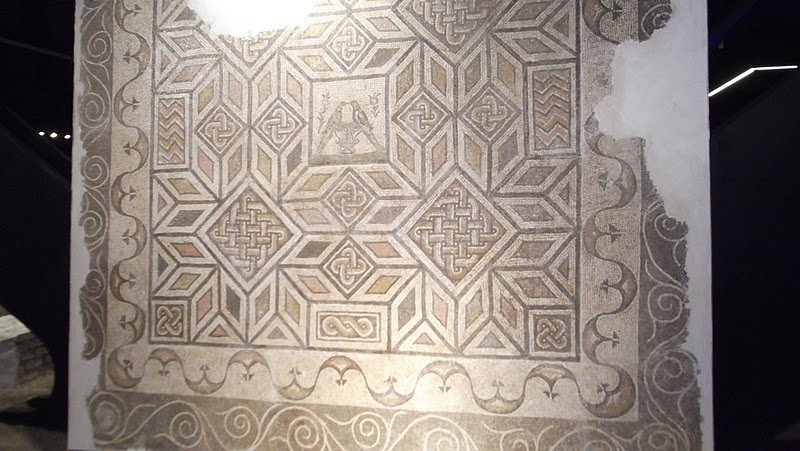
En esta casa se ha encontrado un mosaico en buen estado
In this house a mosaic has been found in good state
Otros restos dentro del museo "Antiquarium" son los siguientes :
Casa del Sigma - Hospitium de los delfines - Patio del océano con pinturas murales de 3 metros.
Other remains inside the museum " Antiquarium" are the following:
The House of the Waterwheel - Roman house - The House of Thes Basas - The House of the Nymph - The Bacus' House - The House of Sigma-The Dolphin Hospitium - The Ocean patio with wall paintings 3 meters high
jueves, 4 de agosto de 2011
La Higiene en el Imperio - Hygiene in the Empire
La higiene personal y pública (saneamientos ,cloacas, colectores ) era algo muy importante en el Imperio, el gran desarrollo de la ingeniería civil permitió la construcción de redes de canalización de aguas sucias y limpias.Aún hoy en dia utilizamos arquetas , colectores ,cloacas ,tuberías como hacían los romanos hace 2000 años. La Edad Media supuso una gran regresión en la higiene ,la falta de la misma favoreció las plagas que diezmaron la población en Europa en varias ocasiones como ocurrió con la Peste Negra.
The personal and public hygiene ( plumbing, sewers,drains ) was very important in the Empire , the great development of the civil engineering allowed the construction of networks of canalization of clean and dirty waters .Even today we use manholes ,drains ,pipes as the romans did 2000 years ago.The Middle Ages involved a regression in hygiene , the lack of the latter favored the plagues that decimated the population in Europe on many ocassions as it happened with the Black Death.
Las letrinas públicas

Las letrinas eran lugares donde los ciudadanos podían hacer sus necesidades, el orín era reutilizado para curtir el cuero y blanquear telas , por eso había un canal que se puede apreciar en las imagenes ,este canal llevaba el orín a un contenedor .
The public latrines
Latrines were places where the citizens relieved themselves ,the urine was recycled to tan the leather and whiten the cloths , for that reason there was a canal as the photos show taking the urine to a container.
Las Termas
Para los romanos las termas no eran sólo un lugar para la higiene personal sino también un lugar de socialización donde se podía comer, hacer deporte , escuchar música ,etc.
Disponían de varias habiraciones con agua caliente, templada y fría .También había vestuarios ,gimnasio y tiendas en el exterior del edificio
The Baths
For the Romans the baths were not only a place for the personal hygiene but also a place of socialization where people could eat ,making sports ,listening to music and so long.
They had several rooms with hot,warm and cold water.There were also changing rooms, a gym and shops outside the building.
 |
| Piscina de las termas de Zaragoza Swimming pool at the Zaragoza baths |
El aseo personal
Los romanos no utilizaban el jabón, frotaban su cuerpo con aceite perfumado y poteriormente lo retiraban con ayuda de un instrumento llamado estrigilo, era un raspador en forma curva que arrastraba el polvo y las células muertas de la piel.Cuando los romanos acudían a las termas solian levar colgado al cuello el estrigilo y una bottelita de aceite (ver photo a la derecha).
The personal hygiene
The Romans didn't use soap, they rubbed their bodies with parfumed oil and later they took it away by means of a device called strigilo , it was a kind of bent scraper that carried away the dust and the dead cells of the skin.When the Romans went to the baths they used to take with them , hanging from the neck, the strigilo and a little bottle of oil (see photo on the right).


Utilizaban toallas de algodón y esponjas marinas que traían consigo a las termas .
They used cotton towels and marine sponges that brought with them to the baths.
Cloacas y canalización del agua potable

Para la canalización del agua potable los romanos utilizaban el plomo, hoy en día nocivo para la salud, sin embargo el plomo se ha utilizado en las cañerias hasta no hace muchos años.
Los romanos fabricaban planchas de plomo que doblaban con la ayuda de cilindros de madera , posteriormente unían los bordes con plomo fundido, para unir las tuberías utilizaban una piezas cuadradas de plomo sobre las que vertían plomo fundido para hacer las uniones estancas.
Sewers and canalization of drinkable water
For the canalization of drinkable water the Romans used plumb, today it is considered to be harmful for health, however it has been used in pipes till not many years ago.
The Romans made sheets of plumb that bent with the help of wooden cilinders ,later on they joined the edges with melted plumb, to join the pipes they used squared pieces to which they poured melted plumb to have the joints sealed .
Las aguas residuales circulaban por las cloacas , en España existen algunas cloacas de gran caudal como la de Cesaraugusta (Zaragoza).
The residual waters went through the sewers , in Spain there are several sewers with big flow volume as the one of Cesaraugusta (Zaragoza).

Debajo puede verse una foto de la cloaca máxima de Cesaraugusta que discurría por debajo del foro, hoy en día la Plaza del Pilar .
Below there is a photo of the great sewer of Cesaraugusta that went thorugh under the forum , today The Pilar Square .

Dabajo se aprecia una imagen de la cloaca de Itálica .
Below there is an image of the sewer of Itálica.

Suscribirse a:
Entradas (Atom)